from The Overlander Project: Two Monks and a Lady
I had been
gone from home almost a year in 1973 before I met a robed Buddhist monk. It is
likely a good thing that the second encounter came less than a month later, or
I probably would have been turned aside from the spiritual path that has come
to mean so much to me in this life, for two such opposite men could hardly be
imagined. Nor could I have predicted the unique woman who brought me into contact
with them both.
I met the first monk when I
was traveling on a train in Thailand, wending my way northward towards Bangkok
with this woman, a friend I had just encountered for the second time on the
“traveler’s road, the route across Asia from Australia to Europe that thousands
of western backpackers traversed in the seventies and eighties. She was a merry girl of 22 or so named Patsy,
a plump blonde nurse from Australia “on walkabout” from her job in Perth with
the odd and single-minded goal of deflowering as many Asian men as opportunity
allowed. I first encountered Patsy
traveling deck class on a freighter from Denpasar to Singapore, enduring
together plates of rice and fish heads, crowds of Indonesians and Malays, daily
thunderstorms, and the blast of Muslim prayers on the loud speaker above our
heads at 5am each morning.
I had been feeling quite lost on the day I
first met her. I was newly broken up
with an American boyfriend who had been my traveling companion across Australia
and Indonesia for four months, and I was feeling very much alone and unsure of
myself as I passed over my ticket and mounted the gangplank into the rough and
alien surroundings on the freighter. There seemed nowhere to sit that wasn’t
already occupied with Indonesian families on blankets, the frontiers of their
territories stapled down with boxes of live chickens, reeking pyramids of
durian fruit, crawling children and piles of other belongings. And then in the confusion, there was Patsy,
beckoning. She sat in a protected outdoor corner on her blanket in the midst of
her parcels and radiated welcome like human sunshine, throwing back her bright
head to laugh with sheer delight at meeting me. She did this, I soon learned
with any new person who happened by, offering those who sat with her a piece of
ripe papaya or a spoon full of the precious peanut butter she had brought all
the way from Perth. She also offered flashes of hirsute privates to stunned
passersby as she shifted position in her short summer dress, for she routinely
dispensed with such niceties as underwear. When, after an hour getting to know
each other, I delicately pointed out this social gaff, thinking she must be
unaware of it, she laughed some more. In fact, she said, she found it fun to
watch the reaction.
At first, I was taken aback by this, since I
have always lived by a more conservative code, most especially while traveling.
But the more we talked, the more I came to appreciate this singular woman. I
had never met anyone so casually good-humored about sex. As she explained her
happy goal of deflowering Asia’s young manhood, neither propriety nor the
potential for male aggression seemed to concern her a jot. Nor did any worry of
heavenly wrath cross her smooth tan brow. She was as blonde and generously
voluptuous as a character in a Felini movie. She loved sex. She loved men. And
she was on holiday. What was more natural than to combine all she loved in this
cheerful project? The gratitude of the young men deflowered so far had made her
feel she was doing something useful with her life. And indeed, as I ran into
her in other places, she seemed to be carrying out her program enthusiastically
– and always with the greatest affection towards one dizzy young man at a time.
When it was time to leave, she said good-bye with tenderness, and I am sure
changed many a fellow for life with her ardent “yes!” to what is so often a
“no” in Asian cultures, especially Muslim ones.
It was a good thing, in fact, that she was a traveler, and never long in
one place. Her devotees would surely have lined up round the block if she had
stayed more than those few days.
 |
| Patsy on the freighter from Denpassar |
She
was kind to women too, kind to me. She went out of her way to cheer me (still
smarting from my recent breakup, even though it had been my own doing). She
made me laugh with funny stories. She guided me into the cavernous bowels of
the freighter, where several hundred higher paying passengers had laid out
their blanket worlds under shelter, to a hidden corner where a cheerful muslim
in a turban served kopi susu,
wonderful rich coffee layered with condensed milk in artistic lines of white
and dark. She lent me all the strength of sisterhood; in fact, her helpfulness
later in my journey may have saved my life. But I am getting ahead again in
this already chronologically challenged story.
In
Singapore, the ocean journey behind us, we hugged good-bye on the gangplank,
each going our separate way. It was several weeks before I ran into her that
second time. This was on Penang Island in Malaysia. I cannot now remember many
details of how it came about, only the timing. It was still early morning, the
tropical air fresh and filled with bird song when the police released me
from Penang Prison, with eighty other westerners they had arrested in the
seaside village of Batu Ferengi the night before. We had had an eventful twelve
hours, rousted out of bed in the dark by soldiers holding rifles, our gear
searched, our passports confiscated, and our persons herded into open trucks
with wooden slats. In these we were
transported under a full moon through the jungle to the prison in Georgetown.
“Why are you doing this?” the more daring among us demanded. But in fact we all
knew. We had been warned when we entered Malaysia not to go to this place, long
a favorite way station on the “traveler’s” trail across Asia. It was an idyllic
fisherman’s village on the eastern coast, with a café that had a pet monkey and
the tropical sea lapping on the beach only yards from cozy seaside huts that
rented for only fifty cents a night. Its forbidden status doubtless came from
the fact that it would very soon present serious competition to a Hilton Hotel
that an American cartel was building with Indonesian co-sponsorship only half a
mile up the road. Future tourists would be confused. Billionaires might lose
money. The situation could not be allowed to continue. And so it wasn’t.
I
had not been particularly alarmed by the experience of being arrested. We were
eighty strong after all, privileged young adults from a dozen western
countries, most from well to do families. No government would dare to hold us
hostage or seriously punish us for such a mild offense. No drugs were found in
anyone’s luggage. No moral turpitude was revealed as passports were confiscated
and ferociously scanned by military clerks that night . All co-habiting couples
actually turned out to be married - to the military’s chagrin and our own
general amazement. In the end, they simply cancelled our visas for not heeding
the warning and gave us 24 hours to get out of Malaysia. “Westerners like you
might streak,” was the odd official
explanation. No attempt was made to expand on why we might streak only in Batu
Ferengi. Indeed most of us had left home before the 1970’s mania to run naked
at public gatherings had even begun. Several of us had to have the concept
explained.
I
was standing at a wharf in Georgetown the next morning, waiting to board the
ferry to the mainland, when Patsy came into my life again. A small motorcycle
driven by a mournful young Malay journalist pulled up. And there behind him,
arms about his waist, was Patsy, with all her gear. The adoring young man tried to be helpful as
she unloaded, but he also kept up a steady stream of argument as to why she
should stay on Penang Island forever and become his bride. At last he appealed
to me to convince her to stay, but I could only smile in sympathy. We all knew
that was not going to happen. Patsy and I waved from the ferry as we pulled
away, and his forlorn shape grew smaller, and for once she looked rueful. This,
after all, was the down side of deflowering virgins. You tended to break their
hearts when you rushed out of their lives.
It took the rest of the day and into the
evening to reach the border with Thailand. With only twelve hours left on my
visa, I had to make it at least that far before we stopped for a rest and Patsy
was happy to oblige. In Thailand now, we
continued north on the train again the next day, passing through small towns
and jungled hills, overnighting at last in Songkhla with its seaside cafes. On
the third day we determined to head for Surat Thani and take the ferry to another
favored traveler’s destination, Ko
Samui Island, but it was here that fate had other ideas. Across the aisle from us, as we jolted
northward that morning, settled a most remarkable character. He was an
orange-robed Buddhist monk in his early thirties, yet he entered the train car
like a king. Or more accurately, he strode down the aisle like Yul Brenner in The King and I. I think he even walked
with his toes curled upward, radiating imperial energies. Other monks had come
to see him off, carrying a startling array of boxes and belongings for one
ostensibly living a life of renunciation. They continued to treat him like
departing royalty, salaaming backward out the door to the platform and bowing
in a line over neatly prayerful hands as the train left the station.
I
cannot now remember this man’s name, so I will call him Gan, a common Thai
name. Gan spotted us across the aisle immediately, and unlike the normally shy
reserve shown by other Buddhist monks in Thailand, who are constrained by
strict vows to avoid even accepting an item from a woman’s hand, he instantly
began an enthusiastic conversation in broken but serviceable English. He
pronounced himself a famous Buddhist scholar, going home on a break from his
Pali studies institute to his home village of Nakon Si Thammarat. He wanted to
know our names, our nationalities, our purpose in visiting Thailand and our
plans. And as the green miles rolled by, and he gazed into Patsy’s mischievous
green eyes, he grew more and more animated. He would not always be a monk he
volunteered, leaning closer. In fact, he said, he was storing all the many
offerings made to him at the home of his sister against the day – not far away
now - when he could disrobe and run for parliament.
Listening
from behind Patsy’s turned shoulder , I found his torrent of conversation,
liberally adorned with self-serving descriptions of his importance and prowess
as a monk, to be off putting in spite of his charm. Was this what Buddhists
were about? I had glimpsed them before of course, walking in solemn pairs or
groups outside the train windows. I had heard that it was the custom for Thai
men to take robes briefly as youths, often for only a few months, and then go
back to lay life. It was accepted that this common toe dip into religion was more
like an Asian boy scout experience than any real spiritual quest. But this man
had made a true career of it, reeling in donations from awed villagers for what
sounded like over a decade. At last, as
his station grew near, he made so bold as to invite us to get off with him at
his village as his personal guests. Patsy threw a bright glance at me over her
shoulder. “Okay?”
I
was startled. “Get off with this monk?
Here? What about Ko Samui?”
“It
will be such an adventure,” she urged.
“I’m definitely doing it. You have
to come with me.” And so we disembarked from the train at Nakon Si Thammarat
station and did indeed begin a remarkable three day visit.
His
sister’s family was there to welcome us as we stepped down from the train, and
with them half the people from his village. And again we watched Gan relish the
role of returning prodigy, accepting the bows of the people lining the roads to
his sister’s house with a masterful raise of the eyebrows and a dismissive nod.
He seemed suddenly swathed in holiness and dignity. Behind came his nephew and
niece, sister and brother-in-law, a tall, massively fat man of Chinese descent,
overseeing the many volunteers who leaped forward to shoulder his donated
hoard. As his venerable western
visitors, we were kept close by his side. We tried vainly to look venerable,
straightening our backs and nodding to the devotees, following his lead.
The house
we finally reached was a modest but well made structure of light woods and
bamboo, every piece of furniture with legs sitting atop boxes full of Gan’s
treasures. Proudly he pointed out a picture of himself as the handsome star of
his local high school, taken before he had gone off to become an important personage. We were startled
to realize there were two people holding trophies in the picture, himself and
his equally proud and lovely twin sister, for she, he acknowledged with a
raised chin in her direction, had also received highest marks. We turned in astonishment, really seeing for
the first time the pretty woman who had helped escort us. She smiled shyly
back, welcoming but pained somehow. The reasons for this became clear in the
days that followed.
Gan’s
enthusiasm for his new role as celebrity host was boundless. He took us
shopping through the outdoor market when the two of us volunteered to make a
spaghetti dinner for the family, not realizing that this could only be done in
Thailand with egg noodles. Gan smilied regally as people stopped whatever they
were doing and kowtowed. He took us to the local Buddhist monastery, where he
sat ramrod straight and crosslegged for pictures, eyes closed, and did his best
to look as contemplative as the statues of Buddha around him. As soon as the
cameras stopped clicking in each location, he grinned and leaped to his feet. He took us to a beach, splashing barefoot
along the tide line with dozens of villagers following awestruck behind us as
he gesticulated and pontificated, and also, quite openly, began courting Patsy.
That he was able to do this full voice in public was due to the fact that no
one in the village spoke English except us three.
I found
myself uncomfortable witness to this strange conversation, as he offered every
impassioned reason why she should sleep with him as soon as practically
possible. Mortified for the devout villagers following this charming hypocrite,
I did my best not to show my feelings on my face, and I saw Patsy did likewise,
for once refusing carnal knowledge. “I draw the line at monks,” she confided
later. “That’s just wrong.” I was glad
to hear it.
 |
| The photo "Gan" gave us to remember him by. |
I think in
all that village, only his sister understood what was going on, for she
accompanied us everywhere. And I saw the dismay in her eyes as Gan freely
flirted with Patsy back in the privacy of their home, stretching next to her on
her bed and casually sharing, against his vows, family photos directly into her
hand. Washing the dishes with her back to him, pretending not to notice, his
sister said nothing, but I could see she frowned.
While Gan
postured at the temple, I had also observed the genuine devotion this woman
showed in the presence of the statues. It pained me, and increasingly, it
angered Patsy that Gan seemed so heedless of her efforts to refuse him. He seemed oblivious of his sister’s feelings,
or more likely they simply did not matter to him. How much more did we begin to
appreciate her as we watched, each day, as she served her family, for they were
quite horrible, all of them. The giant husband was a lout, her two children,
following his lead, rude and self-absorbed. Yet there she was, a radiant,
intelligent, beautiful flower of a human being who had apparently been sold
into marital slavery while her brother, once high school was done, had received
every opportunity and honor. It became clearer, by the hour, that she was the one
who truly deserved honor. She met the
pain of her unchosen life with quiet dignity, and meditated at a small home
altar with true hearted radiance of spirit. And for all we must have seemed
loose women to her, she treated us only with greatest kindness and respect and
never openly criticized her brother.
We had, in
the end, only one way to show our feelings in this matter. On the evening we
left, leaning out the train window, we offered one token of our thanks to that
family, and it was only for her: an exquisite and expensive silken woman’s
sarong. Her eyes widened at the sight of it and she broke into tears as we
placed it into her hands. She followed the train several yards as it began to
move, thanking us, clutching the beautiful cloth with one hand, and reaching
out with the other as if, with all her heart, she would have liked to come with
us and leave that life behind. The men
behind her, Gan included, looked puzzled.
And so the tableau vanished behind us, becoming only another travelers’ dream as so many good-byes on
our journey north had already done.
But that
village had not entirely finished with us yet. By the time we got on the ferry
to Ko Samui, I had begun to run a fever. And on the long choppy voyage across
the strait, sitting on the floor of the small ship with the other passengers in
a low-ceilinged galley, it had begun to rise in earnest. By the time we got to
the island, I was so weak Patsy had to carry the gear for both of us. It took
all my strength and twenty minutes to walk the two blocks to the hotel and up
the stairs to our room.
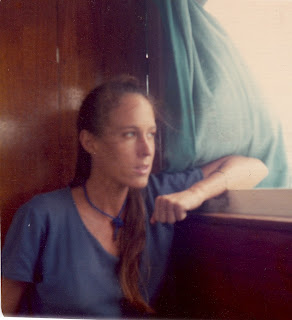 |
| On the way to Ko Samui island, already feverish |
Here I
stayed, prisoner to my mystery illness, for the next three days, while Patsy explored the island by motor bike and no doubt continued her international
neighborliness project, though she brought no one into the room. In it, I lay
alone through violent chills and endless baking hours, taking aspirin eight a
day to hold the chills at bay. This was perhaps not the wisest course, for my
stomach began to hurt as well and day by day I grew weaker. It seemed to me I
must surely be dying. But, oddly, this thought seemed not at all alarming,
merely peaceful. I watched the leaves of a palm tree visible from my second
story window shift and whisper in the tropical breeze, scattering light. I
slept, and watched some more. When Patsy came back, she took one look with her
seasoned nurse’s eye and announced we were going to the hospital in Bangkok, at
once.
I
protested. I did not remotely have the strength for such elaborate plans. I
would stay here and she could go. But, bless her, she was having none of it.
She rolled our few belongings into our backpacks with nursely precision and got
two of her new admirers to carry it all to the ferry. I came behind, just
managing to stand up and weave unsteadily to the departure wharf. Of the return
ferry ride itself I have no memory. I do remember the fight over train tickets
on the mainland. Patsy, it turned out, could be quite ferocious in a pickle.
She demanded that I was to have two seats (I could no longer sit upright). She
would pay for the extra one. No, she wasn’t interested in hearing how full the
train was.
As we
waited for the train to arrive, she urged me to eat, and I remember looking at
the food she offered. I could not have been less able to eat if she had handed
me rocks. I could barely manage to swallow water. And it had been many days now
since I had eaten. My knees threatened to buckle when I stood.
And so we
boarded the train. I remember feeling guilty as I lay keeled over on my small
hard double seat, but in truth, I no longer had any choice. Passengers forced
to stand all along the aisle looked down disapprovingly, but Patsy glared right
back and prevented all incursions. I had no opinions. Sideways, I studied a
young American sitting opposite in the facing seats, an American soldier on R
& R from the Vietnam War, still underway 400 miles to the east. I remember
his handsome young head raised and twisted to take in the sight of the moon
flashing by through the ranked palms. He barely spoke the whole way, as remote
from us as a wild animal in a cage. He seemed to yearn outward at the beauty. I
was too far gone to think about why.
He had
disembarked before we reached Bangkok and found a taxi. Our travel across that
enormous Asian city was a blur to my fevered mind. I have no memory of how it
was accomplished. I was focused entirely on the pain in my midsection, steady
and sharp and frightening within the roar of the fever. Patsy got me first to a
hotel room she rented and then to the Bangkok Christian Hospital in a second
taxi. There she left me in the examining room, promising to visit.
Those first
hours are almost gone now. I remember wracked anxiety and a fumbling late night
phone call to my mother in California, and an IV that somehow got placed below
the level of my heart for a time. I gazed in uncomprehending wonder as my red
blood started up the tube toward the bottle until a horrified nurse caught the
error. A tray of food came the next morning, and on it was a neat little card
typed “Died Card” above my name. I still could not eat, but I tried to sort out
why they should wish to feed me if they thought I had died, until I realized it
was just a spelling error. Diet Card. I lay and watched the ceiling fan go
round, laughing weakly, and breathed the omnipresent scent of tiger balm. The Thai women on the ward around me used it
for nearly every ailment imaginable. The woman opposite was smearing her
midsection against uterine cancer, and reached out brightly, offering some. I
shook my head, but tried to thank her, before falling once more into a deep
sleep.
I was in
the hospital all together five days, a not unpleasant memory in all, because
the Thai staff took good care of me and each day I grew better. My doctor swept
in each midday with a coterie of students, a brisk, no nonsense man more
interested in instructing his followers than saying much to his patients. Still, he had them keep the antibiotic drip
going until I began to surface. Gastritis was the diagnosis, from the fever or
from the aspirin I had overused to treat it, the doctor could not say. But in
either case, the fever began to subside and I could eat again. I tried tiger balm. I chatted with
the British girl next to me, the petulant mistress of a Thai businessman whom
she feared losing with her illness. Patsy came to see me, and one day even Gan
appeared, an attendant in tow, and generously blessed all my hospital furniture
before sweeping out again. Patsy rolled
her eyes. It seemed he had fallen so in love with her, he was still in
determined pursuit.
She saw me
home in the end, if home one can call it, a genteel old style Thai hotel with
potted palms and geckos on the walls of spacious rooms with ceiling fans. These
were mostly filled with western backpackers like us. There was even a swimming
pool of sorts, and she introduced me to some of the friends she had made there
and we sat in the shade and drank lime coolers with them. And then she left –
headed onward to Burma, or perhaps just away from Gan. She left with that
irrepressible smile and a green-eyed wink and I never saw her again, or heard
what became of her. But I visualize her now as a joyful aging matron at the
heart a large Australian family. May it be so.
And so I
floated alone back into the course of my own life. They were happy days in that
little hotel. There were the new friends for company, and there is a kind of
deep peace that comes after serious illness. Life is washed clean and starts
new again. And in that frame of mind, I discovered one day a small card propped
on the manager’s desk. “Lectures in
Buddhism in English” it read. Wat Baworn, Banglamphoon. The first lecture would
be that very evening.
I don’t
remember anyone going with me when I left that night, in sarong and Hawaiian
shirt and flip flops, taking a small bimo
van, to a bridge that looked down on the great lighted Buddhist temple in
the grounds beyond. I remember the air as I walked toward it, soft as warm silk
on my skin. I had a vivid awareness of beauty all around me, soft lights in the
windows of the temple, the smell of frangiapani, the flowing curve of water
below. And anticipation, of what I did not yet know.
At
the temple I was escorted to a small unadorned room where a handful of
westerners sat awkwardly cross-legged, looking around curiously. There were
also two Americans near the front, dressed like Thai monks, their heads shaved.
The lecture that night, they informed us would be on “Sila,” morality. And so it was.
A
tall gaunt long faced Englishman entered at last and sat on a small dias in
front. He smiled at us, and began to
talk. Phra Khantipalo was his name, he said, and he had become a monk eleven
years before, following the rigid code of ordained morality in this temple,
doing the intensive “rains retreats” each summer. I remember only a little of the lecture he
gave that night, though there was a brief meditation on loving kindness at the
end. But I do remember the solemn, sure dignity of the man who gave it. He
passed on the teachings 2400 years old with quiet authority and genuine kindness.
Speaking as if each word, each idea mattered intensely to him, and should
matter to us. And I remember their effect on me. How could I forget it? I felt,
to paraphrase Annie Dillard in Pilgrim at Tinker Creek: I had never
known I was a bell, until suddenly, that one day, I was lifted and stuck.
 |
| Phra Khantipalo, about the age I met him. |
The
reverberations of his words lifted me weightless all the way home that night in a state
of exaltation. It was as if I walked in heaven and not on the streets of
Bangkok, now wet and shining with a soft summer rain. I clutched the book he
had given me, and pondered the words the eager American monks had shared with
us as we left. “Meditation is better than an acid trip,” one assured us.
“It
stops bullets,” another claimed. He had become a Buddhist, he said, after
watching this miracle on a battlefield in Vietnam.
But
I had no need of miracle stories. It was the teaching itself that had set off
the bell inside me. Perfecting a life of morality, practicing loving-kindness
and the pursuit of wisdom with deliberation, focusing the mind in stillness.
These were the first of many teachings that brought my whole life, and the
lives around me into focus. They laid my path before me, and still do.
Many
years later I was shown a picture of Phra Khantipalo standing next to my
Tibetan teacher, Lama Yeshe, and I laughed out loud. Another example of the
synchronicity I have come to expect around Buddhist teachers. Maybe they are
all in cahoots.
It
is hard to imagine two such opposite men as Gan and Khantipalo. Yet I am
grateful for having met them both. I have encountered or read about many
spiritual imposters since then. They are legion. Most, like Gan are not bad
men, only opportunistic ones, with little real self awareness. They rarely grasp
the harm they may do, the impoverishment of trust they can cause, on a
matter so vitally important to human happiness. By now surely, if he lives, Gan is a portly and
prosperous Thai government official, who, just maybe, keeps somewhere a picture of a
mischievous green-eyed Australian girl who broke his heart long ago.
Phra
Khantipalo, I am told, went on to become a well known scholar of Pali and a
much beloved teacher to westerners in Australia and Europe, some of whom who
also studied with Lama Yeshe (hence the
picture.) Eventually, like the majority of westerners who became ordained, he
disrobed and married. He himself began
studying Tibetan Mahayana Buddhism in his old age. I will honor his memory all
my life. It was this revelation - that genuine
spiritual guides do exist in the world - that was the gift of my 3 trips and 4
years of travel across Asia. But it was my encounters with Patsy and Gan in
1973 that lead, after such unlikely beginnings, to meeting my
first teacher.
 |
| A self portrait of Cesca taken in Bangkok 1973, the same week as the story |


